
'The assumption is that the lines have been drawn and the two sides (India and Pakistan) have gone to battle. All of us, whether analysts or politicians or citizens or cricketers or housewives, must see the other side as an enemy and must reject everything it says or does even if we gain nothing from it. I am no longer able to subscribe to this stupidity,' says Aakar Patel.

Omung Kumar plays it woefully safe and completely avoids treading on political toes except for a token representation now and then, writes Sukanya Verma.

'If you destroy the assets in Pathankot, you degrade the combat potential of India; you degrade the war potential of India.'
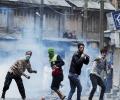
'Burhan Wani's killing served as a spark for the anti-establishment fire that has been raging in the minds of Kashmiris ever since the Centre stopped engaging them for their political future,' says Air Vice Marshal (retd) Kapil Kak in an interview with Rediff.com

'Kargil was Pakistan's strategic blunder. India must remain on guard against such sinister operations being launched in future by Pakistan's vengeful and devious military leadership that continues to have a hate-India mindset and the mentality of primitive warlords,' says Brigadier Gurmeet Kanwal (retd).
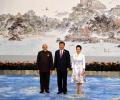
'By crudely dragging the topic into the bazaar to flog it for momentary pleasure, we turned it into a dead carcass by the time Modi even got back from Xiamen,' says Ambassador M K Bhadrakumar.

'While military acts such as the Uri surgical strikes are one option, cultural, economic and diplomatic isolation should also be part of the arsenal,' argues Sankrant Sanu.

'How can Kashmir be demilitarised if the terrorist threat remains and Pakistan continues to incite elements in Kashmir to keep the internal situation unstable?' asks former foreign secretary Kanwal Sibal.

'It will make good sense for military men on that side of the table to be confronted by our own.'
US Assistant Secretary of State for South and Central Asia Nisha Desai Biswal believes the India-US nuclear deal is not in limbo and it is for India and Pakistan to set the pace for conversations to resolve their issues. Rediff.com's Aziz Haniffa reports from Washington, DC.
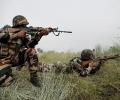
'Both India and Pakistan don't want to escalate tensions.' 'So no matter what is claimed before the public, the reality is slightly different.'
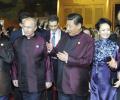
The American, Russian and Chinese reactions to the Uri attack indicates how tough it will be for India to 'isolate' Pakistan internationally,' says Ambassador M K Bhadrakumar.

'Pakistan may feel emboldened to give an upswing to the proxy war in J&K, having secured a better international consensus on its strategic importance.' 'The raising of Pakistani flags by separatists in J&K is an attempt to win psychological space and more of this can be expected as we go into the summer.' 'Pakistan should remain warned that pushing India on this issue will be dangerous.'

'India was in no position to wage another war in 1965, having suffered a morale-shattering defeat in 1962. The three services were in the middle of a modernisation and expansion phase and therefore not fully trained or battle-ready.'

'By the time he came out after nearly five hours, he had a one-to-one conversation with the President, a delegation-level meeting, a reception, a dinner, a tour of the White House and a joint statement of a kind none of his predecessors ever had,' says Ambassador T P Sreenivasan.

Can Modi and Obama forge a common outlook on international terrorism?

'I don't want a government to tell me that I can't be there for my sister's wedding.'
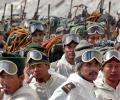
'India should stop claiming that a united Pakistan is in India's interests.' 'Pakistan's break-up is a necessity for peace and progress in the region,' says Major General Mrinal Suman (retd).

The agreement on pricing last month marks a significant step towards promoting energy security in the region, say Nisha Taneja & Samridhi Bimal.
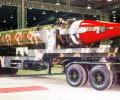
For the world and India, one of the most enduring challenges of the times is for Pakistan's nukes to be neutralised, before they are ever used by the State, their sponsored non-State actors or any rogue elements from the many terror tanzeems dotting Pakistan's unstable landscape, says Lieutenant General Kamal Davar (retd).

'For so long as the rulers of Pakistan remain committed to confronting and vanquishing India, they will sustain delusions, breed terrorists, and export them.'

With Beijing having had a profound rethink on India's admission as a full member of the Shanghai Cooperation Organisation, the tectonic plates of the geopolitics of a massive swathe of the planet stretching from the Asia-Pacific to West Asia are dramatically shifting. That grating noise in the Central Asian steppes will be heard far and wide -- as far as North America, says Ambassador M K Bhadrakumar.

Legendary cricketers Sunil Gavaskar and Ian Chappell tipped India as favourites in their much anticipated World Cup clash against Pakistan.

'General Bajwa is believed to consider the internal threats to Pakistan's security as far more serious than the bogey of the Indian threat.' 'This doesn't mean that he is soft on India, only that he is more rational and sensible than his predecessor who had a bit of a chip on his shoulder about India,' points out Pakistan expert Sushant Sareen.

Not many people in Bangladesh are talking about the Teesta issue.

'All this talk of 'tactical nuclear weapons' or a limited nuclear war are 'false flags'! It looks like India and Pakistan are slowly but surely inching towards this realism,' says Colonel Anil A Athale (retd).

It is in Prime Minister Narendra Modi Modi, officials in Washington believe, US President Barack Obama has found an Indian leader who is willing to walk the talk to realise the common goals of the two countries. Lalit K Jha reports

"On martyrdom day, I pay my respects to Bhagat Singh, Sukhdev and Rajguru who sacrificed their life for the nation," PM said in a statement.

'A couple of hours before the H-Hour, the Kupwara division opened small arms and mortar fire on posts opposite its area of operation.' 'This was a diversionary tactic.' 'As Pakistani forces began to react to the firing, special forces teams began to slowly cross the LoC into PoK.' Nitin Gokhale reveals how planning for the surgical strikes began hours after the Uri attack.

'E Ahamed will be sorely missed as a decent and wise man who made the best use of his political career and personal abilities for the good of the nation,' remembers Ambassador T P Sreenivasan.

'The origins of the model of planned economic development adopted by independent India was a direct consequence of the war.' 'The war provided an opportunity for groups at the margins of Indian society to find new avenues for mobility.' 'The war also led to the emergence of India as a major Asian power and set the stage for it to play a wider role in international politics.'
'For a long time Pakistan dreamt that India would break up and that it would be the predominant power in the region,' says Colonel Anil A Athale (retd).

A war hero looks back at the men and the moments that forged India's greatest military victory.
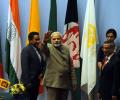
'If his three priorities are the economy, the economy, the economy, then there is need for a stable region, a stable neighbourhood.'

'We should hit Pakistan, continue to prepare for surgical strikes, continue to punish Pakistani posts in the proximity of the LoC and we should start adopting counter terrorist measures.' 'That should be India's action without escalating it to a full-fledged war.'

'Clearly, from the Indian viewpoint, the US retrenchment from Asia cannot be happening as good news.' 'The abandonment of the US' pivot to Asia exposes the US-Indian partnership to be a mere transactional relationship,' says Ambassador M K Bhadrakumar

The India-Afghanistan relationship does not have to be a template of each country's relations with Pakistan, and Delhi will do well to leave it to Ghani to redefine the parameters of Afghanistan's security cooperation with India. A zero-sum mindset can only exacerbate regional tensions, says Ambassador M K Bhadrakumar.

'Pakistan's recent utterances and tendency to use pinpricks to try our patience appear reminiscent of 1965. We are a strong nation, emerging stronger,' says Lieutenant General Syed Ata Hasnain (retd).

Back in 2007, Rediff.com's Sheela Bhatt had profiled Yakub after he was sentenced to death by the Terrorist and Disruptive Actives (Prevention) Act court for criminal conspiracy and financing air tickets to send co-conspirators for arms and RDX training to Pakistan.
Back in 2007, Rediff.com's Sheela Bhatt had profiled Yakub after he was sentenced to death by the Terrorist and Disruptive Actives (Prevention) Act court for criminal conspiracy and financing air tickets to send co-conspirators for arms and RDX training to Pakistan.
